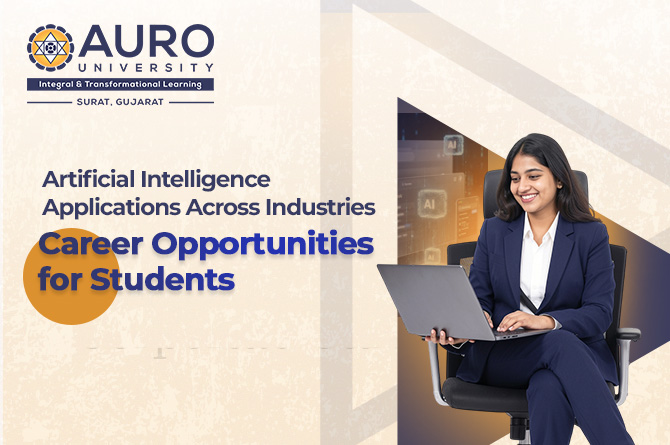
Artificial Intelligence is changing the way industries operate, innovate and grow. What once seemed like a futuristic concept has become a powerful technology that influences everyday life. From personalized recommendations on streaming platforms to intelligent chatbots that assist customers online, AI is becoming an essential part of modern society.
Organizations across industries are adopting Artificial Intelligence to improve efficiency, automate repetitive tasks, analyze large volumes of data and make smarter decisions. This rapid adoption is creating exciting opportunities for students who want to build careers at the intersection of technology and innovation.
As businesses continue to invest in intelligent technologies, the demand for professionals with AI expertise continues to grow. Students who develop skills in Artificial Intelligence today are preparing for careers that could shape the future of industries worldwide.
What Career Opportunities Are Available After an MSc AI or PG Diploma in Artificial Intelligence?
Whether you choose an M.Sc. Artificial Intelligence or a PG Diploma in Artificial Intelligence, you can develop expertise in AI technologies, machine learning, data analytics and intelligent systems.
These skills can prepare you for career opportunities such as Machine Learning Engineer, AI Engineer, Data Scientist, Natural Language Processing Engineer, Computer Vision Engineer, AI Consultant and Research Scientist across industries where Artificial Intelligence is transforming business operations and decision-making.
Why Artificial Intelligence Is Transforming Modern Industries
The modern world generates enormous amounts of data every day. Businesses collect information from customers, operations, supply chains, digital platforms and connected devices. The challenge is no longer collecting data. The challenge is understanding it and using it effectively.
Artificial Intelligence helps organizations transform data into meaningful insights. AI-powered systems can identify patterns, predict outcomes, automate processes and support decision-making at a scale that was previously impossible.
Several factors are accelerating AI adoption across industries:
- Increasing availability of data
- Growth of cloud computing technologies
- Demand for business automation
- Need for personalized customer experiences
- Advancements in machine learning and Generative AI
- Growing investment in digital transformation
Organizations are using AI to improve productivity, reduce costs, strengthen customer relationships and create innovative products and services.
As Artificial Intelligence continues to evolve, industries are discovering new ways to solve complex challenges and improve operational performance. This transformation is also creating demand for professionals who can develop, manage and optimize intelligent systems.
AI Applications Across Industries
Healthcare: Improving Patient Outcomes
Healthcare is one of the most impactful sectors adopting Artificial Intelligence. AI technologies support medical professionals by helping them process information quickly and accurately.
Applications of AI in Healthcare
- Medical image analysis
- Disease prediction
- Drug discovery
- Personalized treatment planning
- Virtual health assistants
- Patient monitoring systems
AI helps healthcare providers improve diagnosis accuracy and support better patient outcomes.
Why It Matters for Students
Healthcare technology continues to expand, creating opportunities for professionals who understand AI-driven healthcare solutions.
Banking and Finance: Smarter Financial Services
Banks and financial institutions process massive volumes of information every day. Artificial Intelligence helps them improve efficiency, strengthen security and enhance customer experiences.
Applications of AI in Finance
- Fraud detection
- Credit risk assessment
- Financial forecasting
- Algorithmic trading
- Customer service automation
- Investment analysis
Financial institutions increasingly rely on AI-powered systems to improve decision-making and operational efficiency.
Why It Matters for Students
The growth of fintech and digital banking continues to create opportunities for professionals with expertise in AI, analytics and intelligent automation.
Manufacturing: Building Smart Factories
Manufacturing companies use Artificial Intelligence to improve productivity, reduce downtime and streamline operations.
Applications of AI in Manufacturing
- Predictive maintenance
- Industrial robotics
- Quality control systems
- Supply chain optimization
- Demand forecasting
- Production monitoring
AI-powered systems help manufacturers improve operational performance while reducing costs.
Why It Matters for Students
The rise of Industry 4.0 is creating demand for professionals who understand intelligent manufacturing technologies.
Retail and E-Commerce: Creating Personalized Experiences
Retail businesses use Artificial Intelligence to better understand customer behavior and improve shopping experiences.
Applications of AI in Retail
- Product recommendations
- Inventory management
- Customer analytics
- Personalized marketing
- Dynamic pricing
- Virtual shopping assistants
Many of the recommendations consumers receive while shopping online are powered by AI algorithms.
Why It Matters for Students
Retail organizations need AI professionals who can transform customer data into actionable business insights.
Education: Enhancing Learning Experiences
Educational institutions are increasingly integrating Artificial Intelligence into teaching and learning environments.
Applications of AI in Education
- Personalized learning pathways
- Learning analytics
- Student performance tracking
- Smart tutoring systems
- Automated assessments
- Educational content recommendations
Technology-driven learning ecosystems are becoming an important part of modern education.
Why It Matters for Students
The growing EdTech sector creates opportunities for AI professionals interested in transforming education through technology.
Hospitality and Tourism: Elevating Guest Experiences
Hospitality businesses are using AI to improve customer satisfaction and operational efficiency.
Applications of AI in Hospitality
- Smart booking systems
- Customer support chatbots
- Personalized travel recommendations
- Revenue management
- Guest experience analytics
- Demand forecasting
Technology integration continues to influence the future of hospitality management.
Why It Matters for Students
Hospitality organizations increasingly value professionals who can combine technology expertise with customer-centric thinking.
Logistics and Supply Chain: Smarter Operations
India’s logistics sector is one of the largest in the world. AI is helping companies reduce costs, improve delivery accuracy and build more resilient supply chains.
Applications of AI in Logistics
• Route optimisation and last-mile delivery planning
• Warehouse automation and inventory management
• Demand forecasting and procurement planning
• Real-time shipment tracking and disruption prediction
• Fleet management and driver safety monitoring
• Fraud detection in logistics billing
Why It Matters for Students
India’s logistics sector is growing rapidly alongside e-commerce expansion. Companies such as Delhivery, Blue Dart, Maersk and Amazon India actively recruit AI professionals who can improve supply chain performance and operational efficiency
How Industry Growth Is Creating New Career Paths
Artificial Intelligence is no longer limited to technology companies. Businesses across sectors are integrating AI into their daily operations, creating a growing need for skilled professionals.
Organizations today seek talent that can bridge the gap between technology and business outcomes. Whether it is improving patient care in healthcare, strengthening security in banking, optimizing production in manufacturing, or enhancing customer experiences in retail, AI professionals play an important role in driving innovation.
The continued growth of AI adoption is creating opportunities in both established organizations and emerging startups. Students who build expertise in AI are entering a field with applications across multiple industries and career paths.
Career Opportunities After an MSc in AI
As Artificial Intelligence becomes an essential part of modern business strategy, organizations are creating specialized roles for professionals with advanced AI knowledge.
An M.Sc. Artificial Intelligence helps you develop technical expertise and practical skills that are relevant across industries.
- Machine Learning Engineer
Machine Learning Engineers build systems that learn from data and improve performance over time. They work on recommendation engines, predictive models and intelligent automation solutions.
- AI Engineer
AI Engineers develop intelligent applications that automate processes, improve efficiency and support business decision-making.
- Data Scientist
Data Scientists analyze complex datasets and identify insights that help organizations solve problems and improve performance.
- Natural Language Processing Engineer
These professionals build systems that understand and process human language. Chatbots, virtual assistants and language translation tools often rely on NLP technologies.
- Computer Vision Engineer
Computer Vision Engineers develop technologies that enable machines to analyze and interpret visual information from images and videos.
- AI Consultant
AI Consultants help organizations identify opportunities for AI adoption and guide digital transformation initiatives.
- Research Scientist
Research Scientists contribute to the development of advanced AI technologies, algorithms and innovative solutions.
- Generative AI Specialist
Generative AI Specialists work with advanced AI models that create content, automate workflows and improve business productivity.
Skills You Need for an AI Career
Success in Artificial Intelligence requires a combination of technical expertise and professional skills.
Technical Skills
- Python Programming
- Machine Learning
- Deep Learning
- Data Analytics
- Cloud Computing
- Database Management
- Artificial Intelligence Frameworks
Professional Skills
- Critical Thinking
- Problem Solving
- Communication
- Team Collaboration
- Adaptability
- Business Understanding
A strong AI education helps you develop both technical and professional competencies that employers value.
Is AI the Right Career for You?
Consider the following questions:
- Do you enjoy solving analytical problems?
- Do you like working with data and identifying patterns?
- Are you interested in emerging technologies?
- Do you enjoy logical thinking?
- Are you curious about how AI-powered applications work?
- Do you want a career that combines technology and innovation?
Understanding Your Responses
If you answered “Yes” to most of these questions, Artificial Intelligence could align well with your interests and career aspirations.
If you answered “Yes” to some of these questions, exploring AI projects, workshops and introductory courses could help you understand the field more deeply.
If you answered “Yes” to only a few questions, foundational AI knowledge can still be valuable because intelligent technologies are influencing nearly every industry.
Future Trends in Artificial Intelligence
Artificial Intelligence continues to evolve rapidly, creating new opportunities for students and professionals.
Generative AI
Generative AI is transforming content creation, software development, customer service and business operations. Organizations increasingly use AI-powered tools to improve productivity and streamline workflows.
Ethical and Responsible AI
As AI adoption grows, organizations are focusing on fairness, transparency and responsible decision-making. Professionals who understand ethical AI practices are likely to become increasingly valuable.
AI in Cybersecurity
Cybersecurity teams use AI to identify threats, detect unusual activities and strengthen digital security systems. This area is expected to generate significant career opportunities.
AI-Powered Healthcare
Healthcare providers continue to explore AI for diagnosis, treatment planning and patient monitoring. Advancements in medical AI are likely to improve healthcare accessibility and efficiency.
Intelligent Automation
Businesses across industries are adopting intelligent automation to improve efficiency and productivity. Professionals who can design and manage automated systems will remain in demand.
Why Study Artificial Intelligence at AURO University?
Building a successful career in Artificial Intelligence requires more than technical knowledge. You need industry exposure, practical learning opportunities and the ability to apply concepts to real-world challenges.
AURO University provides a multidisciplinary learning environment that combines academic excellence with experiential education. Students benefit from expert faculty, industry engagement, modern infrastructure and opportunities to develop practical skills through hands-on learning experiences.
Artificial Intelligence Programs at AURO University
M.Sc. Artificial Intelligence
The M.Sc. Artificial Intelligence program helps students develop advanced knowledge in Artificial Intelligence, machine learning, data analytics, intelligent systems and emerging technologies. The program prepares students for careers in AI engineering, research, data science and intelligent automation.
PG Diploma in Artificial Intelligence
The PG Diploma in Artificial Intelligence offers focused learning for graduates and professionals who want to develop specialized AI skills in a shorter duration. The program introduces practical applications of Artificial Intelligence and industry-relevant concepts used across multiple sectors.
Why Students Choose AURO University
- UGC-recognized university
- NAAC-accredited institution
- Industry-oriented curriculum
- Modern laboratories and learning infrastructure
- Experiential learning approach
- Career development and placement support
- Opportunities for interdisciplinary learning
- Focus on innovation and emerging technologies
Students benefit from an educational environment designed to develop both technical expertise and professional readiness.
Build Your Future in Artificial Intelligence
Artificial Intelligence is transforming industries, creating new career paths and redefining the skills that organisations seek in future professionals. Students who develop expertise in AI today will be better positioned to contribute to tomorrow’s innovations.
Through its M.Sc. Artificial Intelligence and PG Diploma in Artificial Intelligence programmes, AURO University provides opportunities to develop industry-relevant knowledge, practical skills and professional confidence.
Ready to build a successful career in Artificial Intelligence?
AURO University’s M.Sc. Artificial Intelligence (2-Year Programme) offers deep technical expertise in AI, machine learning, and emerging technologies, while the PG Diploma in AI (1-Year Programme) provides a fast-track pathway to gain industry-relevant AI skills. Take the next step toward your future in AI today. Apply for the M.Sc. Artificial Intelligence and Enquire about the PG Diploma in AI .
Admissions open for the academic year 2026-27. Limited seats available.
Frequently Asked Questions
What is the scope of an MSc AI?
An M.Sc. Artificial Intelligence prepares students for careers in machine learning, data science, artificial intelligence engineering, natural language processing, computer vision and intelligent automation. Graduates can work across healthcare, finance, retail, manufacturing, education and technology sectors.
Which industries hire AI professionals?
Healthcare, finance, manufacturing, retail, education, hospitality, logistics, media and technology sectors actively recruit AI professionals.
Is Artificial Intelligence a good career choice?
Artificial Intelligence continues to transform industries worldwide. Organizations increasingly seek professionals who can work with intelligent systems, automation and data-driven technologies.
What skills are required for Artificial Intelligence careers?
Programming, machine learning, data analysis, critical thinking, communication and problem-solving are among the most important skills.
Can students from different backgrounds pursue an MSc AI?
Many postgraduate AI programs welcome students from computer science, engineering, information technology, mathematics, statistics and related disciplines.